

For many adults, the Qur’an is more than just a volume they read; it is their axis of faith, their solace in struggle and loss, the guidance to which they turn again and again. Yet a remarkably large number of people experience a subtle discomfort when they pray. They ask themselves:
- Are my accents on the words right?
- Have I been reading this way for years with the same errors?
- Can I change my recitation now?
If so, you are not alone. Thousands of Muslims across the globe are trying to find Tajweed for adults, people who want a practical way to correct their pronunciation and basically remedy how they recite the Quran without feeling self-conscious or judged.
This article is aimed directly at you – the adult learner who craves clarity, structure, and real progress but also wants to be respected for who they are, spiritually grounded in their new tradition (even if that’s atheism!) and practical, given a busy life.
Why You Still Need to Learn Tajweed As An Adult
Parents are also often exhorted to get their children into Tajweed from an early age, but it does not follow that Tajweed is children’s only domain. Actually, many adults are now revisiting the Qur’an with more commitment and love than when they were children.
Preserving the Words of Allah
Tajweed is not only about a “beautiful voice.” It is about:
- Applying for the correct point of articulation of each letter
- Observing rules that maintain meaning
- Some common pitfalls which can alter meaning
The proper enunciation of the Qur’an is part of healthy respect for the Qur’an. When someone is learning to recite correctly, they’re not attaining perfection for the sake of performance; they’re trying to represent Allah’s words as accurately as humanly possible.
A Different Kind of Maturity
As an adult learner of a new language, you’ve got something children would do anything for:
- You understand why accuracy matters.
- You can understand the layout and clearly defined Tajweed rules.
- You are good at making serious, long-term commitments.
This maturity often equates to very effective adult learning of the Quran – provided that it has been structured with the needs of an adult in mind.
The True Essence of Tajweed – Behind the Technicalities
It can be useful to begin with some straightforward, unambiguous imagery.
Tajweed is the science of pronouncing the Qur’an correctly. It includes:
- Makharij al-Huruf – the point of articulation of each letter (e.g., throat, tongue, lips, nose). Demonstrating where the sounds come from for each makhraj.
- How single letters perform (heavy/light, strong/soft, etc.).
- Rules about how letters interact on the level of sound (i.e., with respect to pronouncing them), such as the rules of ghunnah, idgham, ikhfa’, iqlab, qalqalah, and five different ways to pronounce a lengthened vowel sound (mudud).
Think of Tajweed as the phonetics of the Qur’an with a divine purpose. It is articulation with a high degree of precision in Arabic – but also reverence for revelation.
For adults, this means two things:
- You are not just memorizing rules, but you are physically training your mouth in a very specific way.
- You are reciting the way the Qur’an was handed down from generation to generation.
Why Adults Find Tajweed Too Hard
If you struggle with Tajweed, it is not that you are less intelligent or dedicated. There are real and understandable reasons that adults struggle – and once you can name them, they are easier to not just tolerate but also conquer.
3.1 Long-Standing Habits
Many adults learned to read the Qur’an from family members, local teachers, or self-taught. Some mispronunciations, in time, became unconscious. This is also called “fossilized” pronunciation: habits so ingrained that you perform them reflexively.
Examples include:
- Mixing س and ص, or ت and ط
- Reading ق closer to ك
- Forcing the bold letters to be heavier or making light letters too heavy
Tajweed correction for adults has to be gentle and clear in exposing these patterns.
3.2 Limited Time and Energy
Modern life is demanding. Between work, family, and other social demands, there is little time for extended lessons or intense assignments. Many adults also reside in areas where adult Tajweed classes aren’t readily accessible.
That’s why structured, focused classes and the ability to study Tajweed online is so important for adults.
3.3 Emotional Barriers
There’s another side no one talks about: emotion.

- Too shy to say out loud in front of a teacher
- Feeling like “the only one who does these things”
- I feel like I should have repaired recitation sooner
An effective Tajweed instruction for adults takes these into consideration and cultivates an environment of safety where errors do not lead to humiliation.
3.4 Non-Arabic Background
Arabic is not the first language of a vast majority of Muslims, and especially new Muslims. Other sounds don’t exist in their native language. Examples include:
- ع، غ، ح، خ
- ص، ض، ط، ظ
- Differences between ذ، ز، ظ
These learners must be approached to EFL Arabic articulation for adults in a methodical way: comparison, repetition, and examples should all be clear.
Helping Adults Correct Their Pronunciation Systematically
Tajweed is about pronunciation. Before you worry about every little rule, get to know how each letter comes out of your mouth.
4.1 You Need to Be Seriously Honest with Yourself
The diagnostic reading is the first thing to be done in any serious adult Tajweed course. An experienced teacher hears you reciting passages and makes mental notes:
- Which letters you struggle with
- Where your makharij need adjustment
- How much you focus on simple rules while reading naturally
That gives you a definite point of departure. Rather than wonder, you already know what to work on.
4.2 Special Treatment for Weak Letters
A good teacher will help you move beyond reading long passages:
- Drill a single letter over and over from the right position
- Transition from individual letters to syllables
- Then from syllables to words, and verse by verse
So, for example, if ق is weak, you may work with:
- قَ، قِ، قُ
- قَلْ، يَقُولُ، خَلَقَ
- Short ayat containing multiple examples
This is not grip-and-grin reading; it is focused exercise.
4.3 Listening, Imitation, and Feedback
Three tools, when used together, make a huge difference for adults:
- Listening to reliable, qualified reciters
- Imitating them slowly and carefully
- And receiving feedback from a teacher who can point out those subtle errors
Your ear and tongue grow up together in this process. Slowly, your recitation begins to “feel” different, not merely sound different.
4.4 From Letter to Tajweed Regulations in Context
Once your pronunciation is tightened, you practice real recitation in Tajweed:
- Applying ghunnah and qalqalah through various surahs
- Using idgham and ikhfa in a wide range of examples until you become fluent
- Using madd correctly with and without exaggeration/suppression
Here, you’re not proving that you “know the rule,” but rather that, when you read normally, the rule is there in your recitation.
Creating a Learning Path That Adapts to an Adult Life
If we really want to improve Quran reading for adults, the approach and learning curve must be practical and well-organized. Most adults thrive on a mix of guidance and independence.
5.1 Choosing a Learning Format
You have a few options you might want to consider:
- One-on-one Tajweed tutoring
- Highly personalized
- Convenient for busy professionals or parents
- Small group programs for adults
- Peer motivation
- Shared progress and encouragement
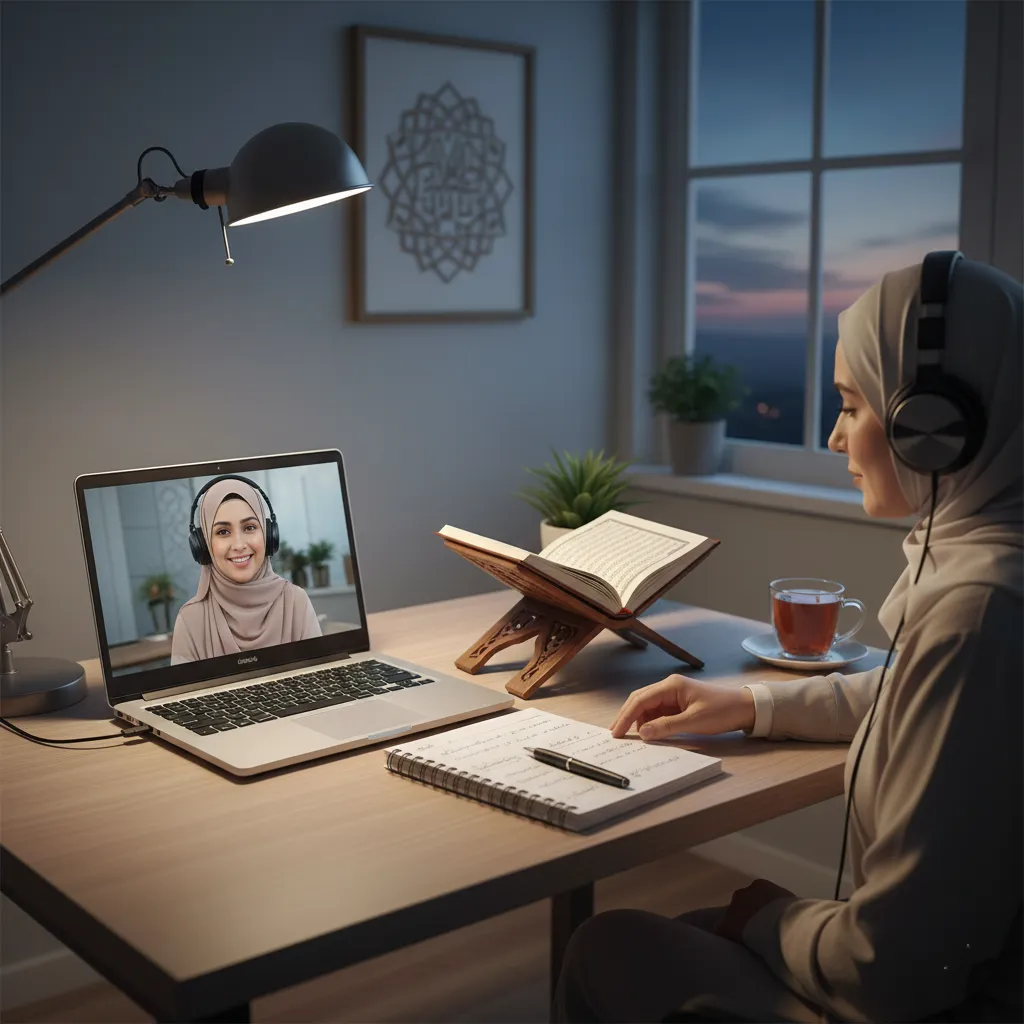
- Online Tajweed classes for adults
- Great for those who are local-less
- Enables you to study Tajweed with online learning options from certified tutors like from Al Hamd Islamic Center.
- Self-paced courses with periodic checks
- Video lessons and assignments
- First live assessments to avoid errors
If you are searching for a course to review, make sure that it has explicit levels, such as Tajweed for beginners and intermediate stages, before moving on to advanced Tajweed techniques.
5.2 A Strong Curriculum for Adults – What to Include
A professionally designed Tajweed program for adults generally offers:
- A well-defined module for the skills you will master at each level
- Weekly practice and correction opportunities
- Homework that’s doable, but worthwhile
- No-holds-barred, respectful, encouraging feedback
- The ability, if you desire, to progress in a type of Tajweed certification
This format respects your time while directing you to actual results.
5.3 Establishing Your Daily Routine in Baby Steps
No course, no matter how good it is, can replace consistency. Many adults thrive on a straightforward, routine schedule:
- Practicing focused for 15–20 minutes a day
- Live recitation corrections once or twice a week
- Continual revision of surahs that are already memorized, with more emphasis on Tajweed
It can also be helpful to associate practice with one of your daily habits (e.g., immediately after Fajr, before bed, etc.) to help continue that momentum during particularly busy weeks.
Assessing Your Real Progress as an Adult Learner
Adult students have a high level of result expectations. They’re there to see their time and effort bear fruit.
6.1 Signs of Improvement
You may notice progress through:
- Needing fewer corrections during lessons
- More comfort with reading aloud
- Identifying and correcting your own errors on the fly
- Listening to recordings and hearing the change in your own voice
A simple way to measure growth is to keep a small log of things you recite, what you stumbled with, and where you improved.
6.2 From Hesitant to Confident
Over time, something deeper happens. You move from:
- The hush of the Qur’an to recitation in calm voices
- From unwillingness to recite in front of others to directing and participating
- From uncertainty in Salah to focused and present recitation
This is not just technical advancement. It’s growth, spiritual and emotional. By practicing the Qur’an in the right way, reciting it with confidence, you get rid of your fear and everything that holds you back from your khushu’ and closeness to the Book.
Being Inspired on a Holy and Sensitive Path
Correcting mistakes in Qur’an recitation over time is a very sensitive issue. It also covers identity, memories of childhood, and sometimes regret. You start to feel the pressure building, and you’ve still got nothing – we understand. It’s important to approach this situation with compassion for yourself and others.
7.1 Retelling the Tale
Instead of thinking:
“I should have learned this years ago; now it’s too late.”
Try to see it this way:
“Allah has allowed me to come to this point now, with a maturity in my personal life where I can really realize it and act on it.”
You are not beginning at zero. You are getting better with what you have.
7.2 Taking Correction as a Present
Whenever a teacher corrects you, what is happening?
- You’re getting closer with that recitation.
- You’re picking up something to hold on to for the rest of your days.
- You are protecting your future recitation, and the recitation of all those who will learn from you.
That’s not so much criticism as it is care.
7.3 Seeking Support and Community
You are not alone on this journey. Consider:
- Enrolling in a circle with other adult learners
- Updating a spouse, sibling, or friend about progress
- Encouraging your children through the gift of being a learner of new things
This is adult Islamic education in flesh and blood form: parents, professionals, community members directly attempting to strengthen their relationship with the Qur’an.
Taking the Next Step
If you’ve read this far, that means you are serious about improving your recitation. Now, the next question is: What will you do with that intention?
Here are some concrete ways you can respond today:
- Pick one short surah you usually recite and listen to it from a trustworthy reciter, reading along. Observe where your recitation differs.
- Jot down two or three letters that you’re certain are hard for you and make those the focus when practicing next week.
- Find an organized adult Tajweed course or instructor, either in real life or online, that provides decent feedback and a professional, respectful atmosphere. Expert Quran Tutors is providing free trial class you can also avail this opportunity.
A good Tajweed course for adults will not bombard you with too much information. Rather, it will guide you in detail, correcting your recitation and applying the Tajweed rules so that they become second nature as you read.
No matter your age, accent, or past mistakes, you are not ineligible for this journey. These factors may even condition you for success. You appreciate the value of time, realize how significant the Qur’an is in your life, and are ready to be responsible for your recitation of it.
With honest intent and persistence, aided by the right guidance from the beginning, this intention will govern you for the rest of your life. You can move from indecision to clarity, from hesitation to confidence, and from halting recitation to fluent, dignified reading that satisfies your conscience.
And Allah knows best.